

Solar panel install and use on an HCH-2


Thread Starter
|
Eco Accelerometrist
Joined: Jun 2006
Posts: 1,191
From: Winnipeg, MB
 Re: Solar panel install and use on an HCH-2
...Do you disconnect it when running your car? I think that the diode would allow it to be permanently connected. Also, the person who I bought it from said I could run the car while it is connected. However, the instructions say not to (but they say lots of things, like the blue LED is red). Just wondering what your personal opinion is.
These panels will tolerate up to 17V and the IMA DC-DC will provide 13.8V maximum- so it is VERY safe. Besides they are protected and you do not need an additional diode in addition to the one they already have. An additional diode would cause current restriction as well as an additional voltage drop.
So placing a "sensitive" fuse in line is the best option just in case the cable ever gets cut or pinched, etc.
Cheers;
MSantos

Thread Starter
|
Eco Accelerometrist
Joined: Jun 2006
Posts: 1,191
From: Winnipeg, MB
Re: Solar panel install and use on an HCH-2
So would any one of these work?
Either the first solar panel (1.2W) or the second (2.4W) would do. I would lean more towards the second.
The solar panels I picked are rated at 1.8 watts which is roughly midway between the two I identified from your link. However, I often use two (1.8W) panels and the total effective rating is actually 3.6 Watts. So the 2.4W unit from your link should be good.
My "MotoMaster/Eliminator" branded panels are available at Canadian tire (stores & online) as you can see in the following link.
http://www.canadiantire.ca/browse/product_detail.jsp?FOLDER%3C%3Efolder_id=140847439 6672995&bmUID=1195782477775&PRODUCT%3C%3Eprd_id=84 5524443275941&assortment=primary&fromSearch=true
I do not know if they ship outside Canada.
Cheers;
MSantos

Enthusiast
Joined: Nov 2007
Posts: 45
Re: Solar panel install and use on an HCH-2
Thanks MSanots
It doesn't look like Canadian Tires ships to US.
I will do some measurements on the dash to see which one will fit better. I don't think I can put it in the back like you as there is not much room in the HCHI and we plan on tinting the windows.
It doesn't look like Canadian Tires ships to US.
I will do some measurements on the dash to see which one will fit better. I don't think I can put it in the back like you as there is not much room in the HCHI and we plan on tinting the windows.

Active Enthusiast
Joined: Nov 2007
Posts: 123
Re: Solar panel install and use on an HCH-2
I know it's just wishful thinking  on my part, but wouldn't it be really nice if Honda would permit [as in, not void warranty] a hack that would allow either solar or AC-line charging of the IMA batteries?
Unlike the ideal plug-in hybrids, this wouldn't require extra batteries, but would likely provide some real gasoline savings. Shouldn't cost much to do.
on my part, but wouldn't it be really nice if Honda would permit [as in, not void warranty] a hack that would allow either solar or AC-line charging of the IMA batteries? Unlike the ideal plug-in hybrids, this wouldn't require extra batteries, but would likely provide some real gasoline savings. Shouldn't cost much to do.
Thread Starter
|
Eco Accelerometrist
Joined: Jun 2006
Posts: 1,191
From: Winnipeg, MB
Re: Solar panel install and use on an HCH-2
Yep, it would be nice.
In order to reduce conversion losses you would need an array of solar panels that would produce at total output worthy of effectively and safely charging the NiMH battery. To put into perspective we would need at least 11-12 solar panels like the ones I have installed in addition to a custom charge controller.
It would certainly work and it may just a be a good project especially after the warranty expires.

Cheers;
MSantos

For my daughter
Joined: Mar 2007
Posts: 96
From: Near Montreal, Quebec, Canada
Re: Solar panel install and use on an HCH-2
Hi MSantos,
I have bought it and used the fuse panel as you show. I have tried it 2 or 3 times last fall but when I started the car the day after, I had the IMA light remaining on (if I remember well). I don't want to unplug all that every day neither, so I want to install a swtich on the cable and try it again. But before. I will try it again this weekend and comeback with the exact behaviour. I put all the cabling away when I returned the car to garage for sensor replacement. I did want them to tell me that the source of the problem is this and the warranty is not good anymore.
If I read you well, you use the car as usual and do not unplug the permanent one. Correct ?
PierreM
I have bought it and used the fuse panel as you show. I have tried it 2 or 3 times last fall but when I started the car the day after, I had the IMA light remaining on (if I remember well). I don't want to unplug all that every day neither, so I want to install a swtich on the cable and try it again. But before. I will try it again this weekend and comeback with the exact behaviour. I put all the cabling away when I returned the car to garage for sensor replacement. I did want them to tell me that the source of the problem is this and the warranty is not good anymore.
If I read you well, you use the car as usual and do not unplug the permanent one. Correct ?
PierreM
Thread Starter
|
Eco Accelerometrist
Joined: Jun 2006
Posts: 1,191
From: Winnipeg, MB
Re: Solar panel install and use on an HCH-2
Pierre, that is correct. I never unplug my permanent panel.
However, the main reason why I do not unplug it is because the panel has a built-in Diode. Without this diode protection the solar panel would discharge the battery at night, and that is simply not good at all.
So, the best way to test that it has the needed diode protection is to plug a digital current meter in series (in a low milliamp setting) with the panel and while the car is out in the daylight measure the current the panel is providing to the system. Then while in that state cover the panel with a dark towel so as to block the light from reaching the panel. At this point you should not see any reverse current flow (negative milliamp values. Instead you should just see zero current.
If there is reverse current then you have no diode protection and you need to place a diode in the circuit in order to prevent the battery from being drained at night. You can buy a standard rectifier diode from any source store or electronics shop.
If your 12V drains too far then you'll get the IMA light for sure.
Cheers;
MSantos
However, the main reason why I do not unplug it is because the panel has a built-in Diode. Without this diode protection the solar panel would discharge the battery at night, and that is simply not good at all.
So, the best way to test that it has the needed diode protection is to plug a digital current meter in series (in a low milliamp setting) with the panel and while the car is out in the daylight measure the current the panel is providing to the system. Then while in that state cover the panel with a dark towel so as to block the light from reaching the panel. At this point you should not see any reverse current flow (negative milliamp values. Instead you should just see zero current.
If there is reverse current then you have no diode protection and you need to place a diode in the circuit in order to prevent the battery from being drained at night. You can buy a standard rectifier diode from any source store or electronics shop.
If your 12V drains too far then you'll get the IMA light for sure.
Cheers;
MSantos

Enthusiast
Joined: Feb 2008
Posts: 10
Re: Solar panel install and use on an HCH-2
This post was submitted as per request for ChrisG and Steve.
My apologies for the (low light)pics ... it was overcast today.
First of all, I should emphasize the not so obvious first: This solar panel installation does NOT tap into the traction NiMH battery ! Instead, it is meant to keep the rather small (in size and capacity) 12V battery topped off.
Now, for the more obvious: My personal HCH-2 actually has two solar panels. One "permanently" mounted at the rear of the car (as shown in the following pic) and another that I have stowed inside which I use on the front dash when I feel like it.
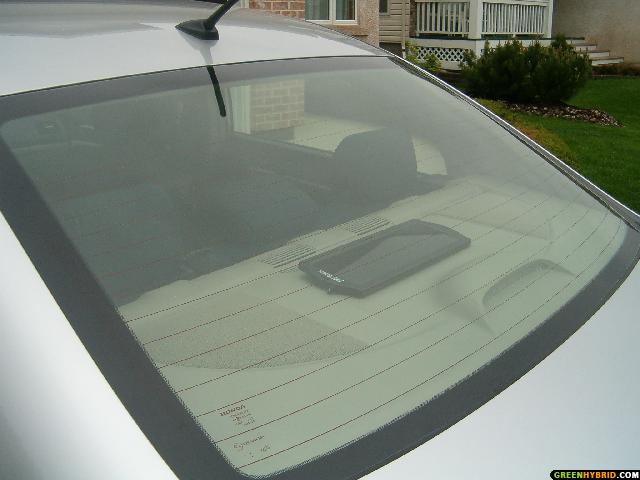
Now for the above, I drilled a hole into the plastic trim and then ran the wiring to the trunk. From the trunk the single wire (+ve) was run past the rear seat into the cabin and then under the carpeting on its way to the fuse box.
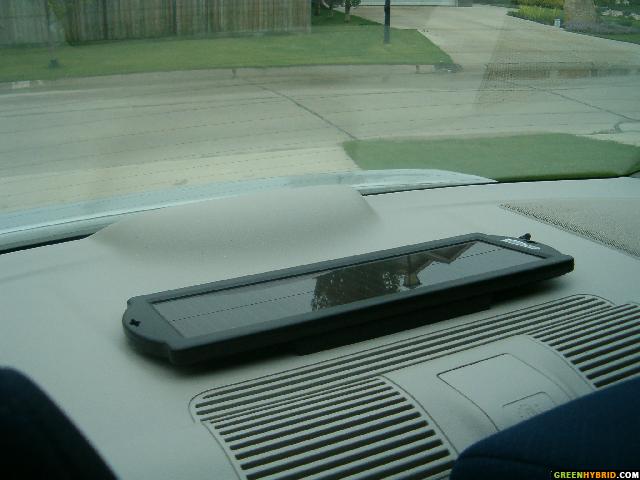
Here's another view, this time from the rear right passenger seat. The solar panel is kept in place with double-sided adhesive (10mm) insulating foam and velcro... so that it is not only noiseless and easy to remove, but also slightly tilted to the back.
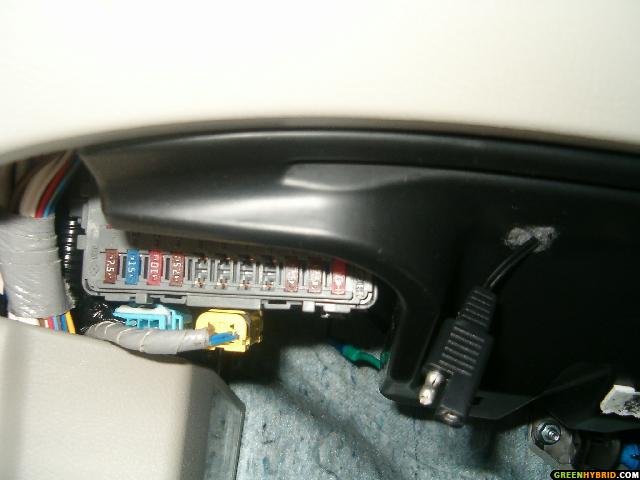
The following pic (not very clear - I'll take another one at a later time) is the fuse panel. I've connected the RED (+ve) feed from the solar panel(s) to this particular fuse position. If you notice, it is an empty fuse position but any other vacant fuse socket will do. Use a multimeter to make sure you plug it in to the correct fuse contact. In this case, the lower contact is the live rail.
The second wire from the solar panel can be connected to any good ground point in the car. For the rear mounted panel, I found a good ground in the trunk which enabled me to run the single wire (+ve) to the fuse panel.

The following pic shows the dangling connector for the second solar panel, which I mount on the front dash whenever I deem appropriate.
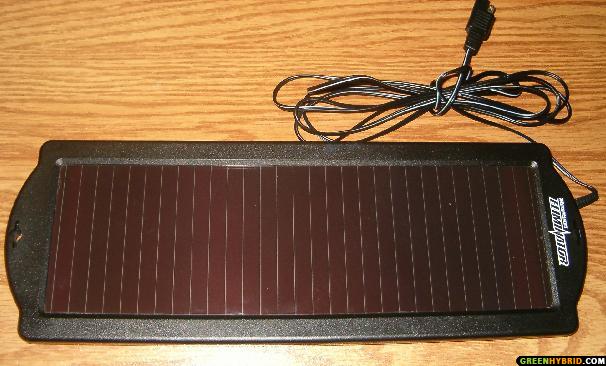
The following pic is a sample of the actual solar panel. I bought quite a few of these at Canadian Tire when they were on sale last year. Pretty good deal I must say. These units will output 40+ mA or more in a sunny day and will also produce good power in cloudy days too
Anyhow, that is all there is for the rather simple install. Does it work? It does for me. As some of you may suspect, it does have a small but measurable positive impact on fuel economy !
If you have a scangauge then watch it work by setting the reading to voltage. Better yet, place a small digital Ammeter (eBay for $20 or less) in series with the solar panel's (+ve) to see the actual current flow. My wife's newly arrived HCH-2 will get a similar install as well - as soon as I get some time to do it that is.
Cheers;
MSantos
My apologies for the (low light)pics ... it was overcast today.
First of all, I should emphasize the not so obvious first: This solar panel installation does NOT tap into the traction NiMH battery ! Instead, it is meant to keep the rather small (in size and capacity) 12V battery topped off.
Now, for the more obvious: My personal HCH-2 actually has two solar panels. One "permanently" mounted at the rear of the car (as shown in the following pic) and another that I have stowed inside which I use on the front dash when I feel like it.
Now for the above, I drilled a hole into the plastic trim and then ran the wiring to the trunk. From the trunk the single wire (+ve) was run past the rear seat into the cabin and then under the carpeting on its way to the fuse box.
Here's another view, this time from the rear right passenger seat. The solar panel is kept in place with double-sided adhesive (10mm) insulating foam and velcro... so that it is not only noiseless and easy to remove, but also slightly tilted to the back.
The following pic (not very clear - I'll take another one at a later time) is the fuse panel. I've connected the RED (+ve) feed from the solar panel(s) to this particular fuse position. If you notice, it is an empty fuse position but any other vacant fuse socket will do. Use a multimeter to make sure you plug it in to the correct fuse contact. In this case, the lower contact is the live rail.
The second wire from the solar panel can be connected to any good ground point in the car. For the rear mounted panel, I found a good ground in the trunk which enabled me to run the single wire (+ve) to the fuse panel.
The following pic shows the dangling connector for the second solar panel, which I mount on the front dash whenever I deem appropriate.
The following pic is a sample of the actual solar panel. I bought quite a few of these at Canadian Tire when they were on sale last year. Pretty good deal I must say. These units will output 40+ mA or more in a sunny day and will also produce good power in cloudy days too
Anyhow, that is all there is for the rather simple install. Does it work? It does for me. As some of you may suspect, it does have a small but measurable positive impact on fuel economy !
If you have a scangauge then watch it work by setting the reading to voltage. Better yet, place a small digital Ammeter (eBay for $20 or less) in series with the solar panel's (+ve) to see the actual current flow. My wife's newly arrived HCH-2 will get a similar install as well - as soon as I get some time to do it that is.
Cheers;
MSantos
how to i obtain a few of these and what exactly is the cost...




